 POINT
Farm points while everyone else sleeps
Delta-neutral farming on autopilot. Point Farmer opens and closes positions, sets stops and take-profits, and racks up volume on top perp DEXes — with no directional risk and no manual work.
The software has a free version, with exactly the same features as the paid one. The one condition: trade from wallets registered through our exchange referral links.
A dashboard built for watching your positions
One panel for every pair you run: volume, cost, cost per $100k, the journal of every cycle with what it earned or paid, wallet balances, and a Telegram bot that reports each open and close.


Points themselves are typed in by hand — exchanges do not expose them through the trading API, so the panel cannot read them for you. It computes what it can actually measure: volume, cost, and the cost of one point once you enter how many you have.
Easy control over your positions
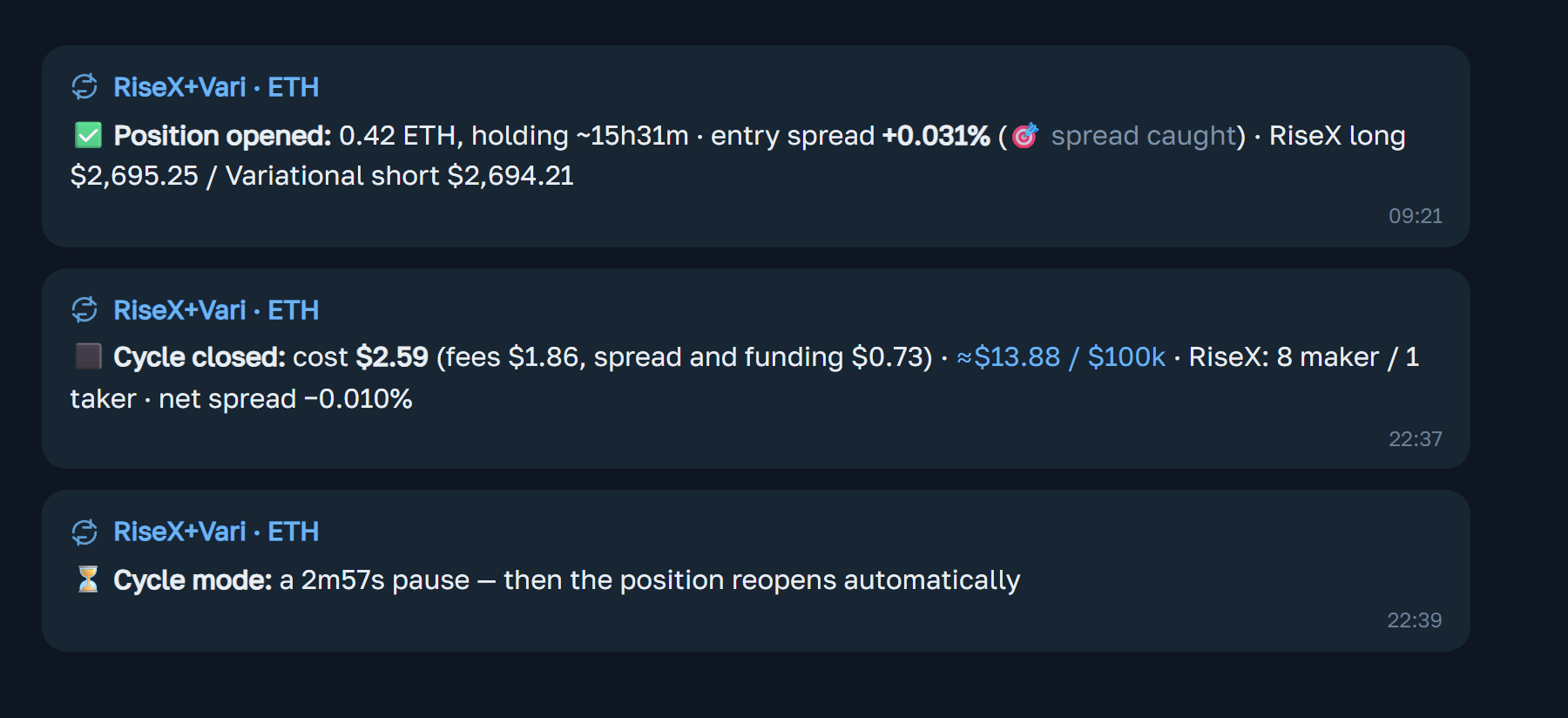
A Telegram bot reports every open and close: position size, the entry price on both legs, the spread it caught, and — when the cycle ends — what that volume cost you.
Commands work the other way round: ask it at any moment and it answers with the status of every running position. Which alerts you want is up to you.
Delta-neutral position, maximum efficiency
One account goes long, another goes short on a different exchange, with the same coin quantity. The market can do whatever it wants: what one leg loses, the other gains. What you accumulate is volume, holding time and PnL — and those are exactly what the points are credited for.
You connect two accounts
Trade-only or delegate keys, entered in text files on your own machine. The software runs on your PC or VPS.
The bot opens both legs
Long on one exchange, short on the other. Entry goes in as a limit order, so the spread is earned instead of paid.
Volume accrues around the clock
Positions are held for hours — exchanges reward open interest over time — then closed and reopened. You watch it from the dashboard.
The net stays exactly zero at any price. That is the entire point: the position carries no directional risk, so the only thing that costs money is execution — fees and the spread on the way out.
The same trades — by hand or by software
Nothing here is out of reach for a person with two exchange tabs open. What differs is how many hours it takes and how much of the spread you hand over before you get to the keyboard.
Same trades, same venues, same keys — and the same safety. The software holds no permission a manual trader does not have. What it changes is the cost of the volume and the hours you spend getting it.
We own the left side of the equation
What a point will be worth is decided by the exchange. What the volume costs per $100,000 depends on the trader — and this is where the software works for you: maker entry, spread hunting and measured cycles drive that cost to the minimum.
Cost is booked per cycle as the change in total equity across both exchanges — not as a price formula that would quietly hide slippage and funding. Roughly half of it is exchange fees; the other half is the spread paid on the way out.

Yield estimate, on the RiseX example
The point rate below is taken from our own RiseX farming: about 400 points per $4M of pair volume. Other exchanges pay differently.
Assumptions: volume from the software's own formula (4 × margin × leverage per cycle, 24 ÷ hold hours cycles a day), cost at the $22 per $100,000 portfolio average, points at the RiseX rate we actually see — about 10 per $100,000 of pair volume. Point accrual differs by exchange, asset and how crowded the program is, so treat that side as an order of magnitude, not a forecast.
Every position stays under your control
The maximum level of safety for your trading: funds stay on your own exchange accounts, and every limit below is enforced by the exchanges and by the code — not by a promise.
Keys never leave your machine
The software runs on your own PC or VPS. Private keys sit in text files there. Only positions, PnL and volume are sent to the dashboard — the request schema has no field for a key at all.
Withdrawal is impossible at the exchange level
Trade-only and delegate keys are permissioned by the exchange itself: they can place orders and nothing else. On Bullet that restriction lives in the chain protocol, not in a settings page.
No withdraw method exists in the code
The exchange adapters implement order placement, reads and cancels. There is no withdraw and no transfer function to call — even a compromised build has nothing to invoke.
Exchange-side stops on both legs
Take-profit and stop-loss are placed automatically on both legs the moment a position is filled — you set how far from the liquidation price the stop should sit, as a percentage. They live on the exchange, so they survive a crash of the bot or the machine, and a guard closes the pair early if margin health degrades.
What a finished program looked like

A past result, not an offer and not a forecast. The size of an airdrop is decided by the exchange, and the same numbers will not repeat on the next program.
Lighter showed what the perp DEX meta is capable of while it lasts. The conclusion is simple: work as many top perps as you can, and get in while their programs are still young — one campaign can pay for all the volume you built across the rest.
Where this software came from
The software was written for the author's own trading. It grew out of the daily work behind the WE NEED CRYPTO channel and ORBIT Perp Screener — first as a private tool for farming points across our own accounts.
Every exchange integration has to be kept alive: venues change APIs, rotate anti-bot protection and break without warning. That work is paid for by the exchanges' referral programs on the volume our users build, and by subscriptions from people whose accounts are registered elsewhere — which is why the software itself can be free. There is no fund, no pooled capital and no share of your result: you trade your own money on your own accounts.
Every pair, across 10+ venues
Each pair puts the limit-order leg on one exchange and the hedge on another, so both accounts build volume while the net position stays flat. Tap a card for the details.
 BTC
 ETH
 SOL
 SUI
 HYPE
 GOLD
 SILVER
 OIL
Not only crypto: some venues list gold, silver and oil as perpetuals, and those books are often where the cheapest points are.
Venue sign-up perks — and the links Open the list
These are the exchanges' own referral perks, not ours to grant: each venue gives them to an account that signs up through our link. The same sign-up is what opens free access to the software.
Perks are what the venues currently give our accounts and can change on their side without notice. Variational is the only venue with a code to type in by hand — everywhere else the referral sits inside the link itself, and entering anything extra gets you an «already applied» refusal.
This is not for you if
- You are not willing to wait. Points turn into money only at TGE, and that can be months away — the biggest multiples go to those who farmed early and sat through the wait.
- You expect a hands-off, set-and-forget tool. You will be topping up balances, watching the panel and reacting when an exchange breaks.
- You don't want side costs: a VPS, residential proxies, and a CapSolver key — the last one only for Variational.
Two ways in — and the main one is free
The software is the same either way: every pair we run, the same dashboard, the same support. One thing differs — which wallets are allowed to trade.
You sign up on the exchanges through our referral links, run the software and trade your own money.
The exchange's referral program pays us a share of what your account generates.
That share pays for the software instead of your subscription — and the sign-up perks on the link go to you.
Wallets registered through our links
Sign up on both exchanges of your pair through our referral links. Those wallets trade with the software for free.
The access holds for as long as those wallets stay registered through our links.
This is decided once — at sign-up. An account already registered somewhere else cannot be moved under our referral later: the exchange counts a referral at registration and never afterwards. For wallets like that the subscription is the only way in — or a fresh wallet opened through our link.
Apply for free accessAny wallets of yours, existing accounts included
If your accounts were registered elsewhere and you are not moving them, the subscription drops the referral condition entirely: any wallet trades.
A subscriber can move onto free access at any time with the same key, and when a subscription runs out the free path takes over by itself — the key does not stop working.
See plansHow free access is set up
- Pick a pairStart the bot and open «Free via referrals» — it walks you to the application form where you choose the pair. The referral links for both exchanges are right there.
- Sign up on both venuesBoth legs of a pair have to be registered through our links. Deposit $10 or more and make any one trade: until there is activity on the account, the exchange may not list you as our referral at all.
- Send the walletsPut the wallet addresses into the form and confirm it in Telegram. The last four characters of an address are enough — they only have to be matched against the exchange referral panel.
- Checked by handEach wallet is matched against the exchange's own referral panel, and the key arrives in Telegram. A wallet you add later waits on «pending review», and while it waits only new cycles are refused.
What starting actually costs: $0 for the software and a $10 deposit on each of the two exchanges. Separately, and not to us: a VPS if you don't leave your own machine running, residential proxies, and a CapSolver key — the last one only for Variational, so the Perpl + Extended pair needs none of it.
The subscription is for accounts registered elsewhere
If your wallets are registered through our links you do not need this block at all: access is free and has no end date. The subscription is for the other case — any wallets of yours, including accounts you already trade from. The first purchase adds a one-time $90 entry fee on top of the plan; renewals are the plan alone.
What access includes — free or paid
- The software — every pair we run, not one
- An access key for two browser devices on the portal — the limit is configurable from one to five, and you can free a slot yourself
- The web dashboard: groups, positions, cost, volume and the journal of every cycle
- Support, and new modules at no extra cost
- A Telegram bot that reports every open and close
- Subscription payment in USDT — TRC20, BEP20 or SOL
You get exactly the same software, with exactly the same features — for free. The one condition: trade from wallets registered through our exchange referral links.
Before you ask
What is the catch with free access?
How long does free access last?
What if I already signed up without your link?
What happens to an open position if my access ends?
Isn't this wash trading?
What if the airdrop never comes?
How much money do I need?
What else costs money besides the software?
Which operating systems does it run on?
I already have accounts on these exchanges — do they work?
How many devices can one key be used from?
Is there a refund or a trial?
The meta won't wait for you
Every week without volume is points going to somebody else, at a price that will never be this low again. Getting in costs nothing if your wallets are registered through our links.
Get access — freeOpens the Telegram bot: free access via referrals, the subscription, and the key.